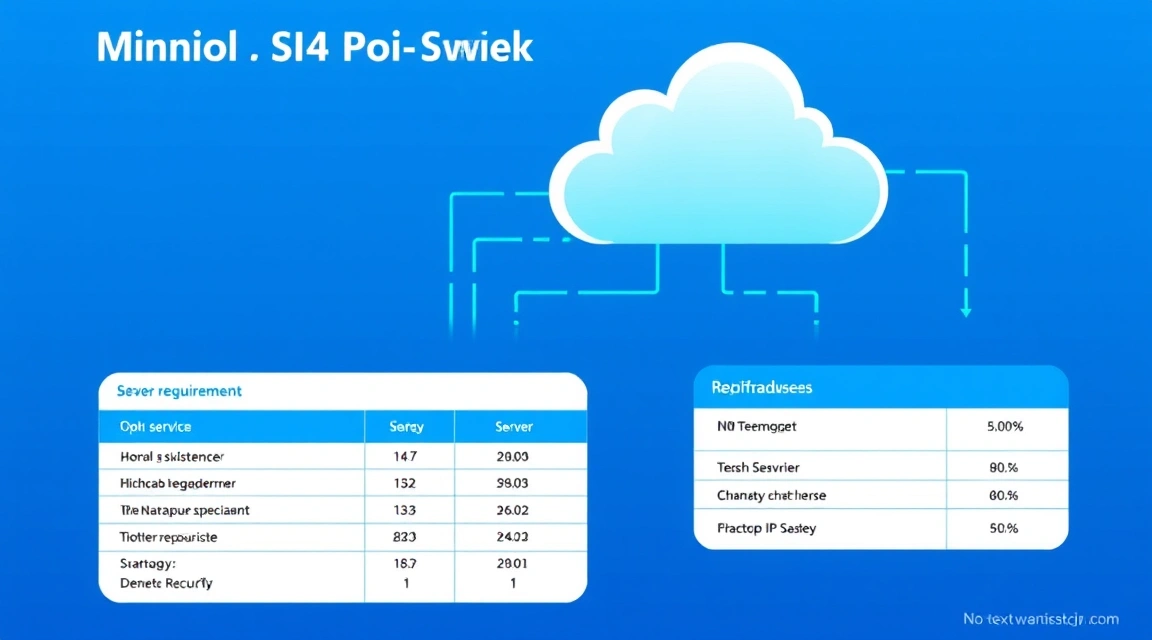
For 10 TB of usable MinIO capacity, you need at least a 4-node cluster with 4–8 vCPU, 16–32 GB RAM per node, 12–24 SSDs/HDDs, a 10 Gbps network, and 15–24 TB of raw capacity for erasure coding.
What are the MinIO server requirements for S3 storage?
MinIO is not a file server
The key minio server requirements are determined not by HTTP request volume alone, but by the combination of usable capacity, object size, concurrent PUT/GET operations, disk performance, and network speed. MinIO stores data as S3 objects and distributes it across disks using erasure coding. As a result, a server with 32 cores, one slow HDD, and a 1 Gbps port will lose to a system with 8 cores, several SSDs, and a 10 Gbps network.
Four resources matter for production deployments: raw disk capacity, the number of independent drives, network throughput, and RAM for the OS file cache. CPU handles checksums, TLS, application-level compression, and erasure-coding calculations, but in a typical S3 workload, the processor is rarely the first bottleneck.
If MinIO runs alongside other services, first assess the overall placement model using this guide to choosing hardware for self-hosted applications. Do not place object storage, a database, CI runners, and a game server on the same array: their I/O profiles will compete.
What to calculate before ordering a server
- Usable capacity: how many TB you need after erasure coding, not the size of the files uploaded today.
- Growth: include projected growth for 12–18 months and a minimum 20% free-space reserve.
- Objects: millions of 4 KB files create more metadata operations than several hundred 20 GB archives.
- Peak throughput: backup uploads, media delivery, and VM recovery require different network resources.
- Fault tolerance: a single server protects against disk failure, but not total node loss; a 4-node cluster can survive a server failure when disks are placed correctly.
How to calculate MinIO self-hosted S3 sizing by usable capacity
Raw capacity is always larger than usable capacity
MinIO self hosted S3 sizing starts with calculating erasure-coding overhead. With a 4 data + 2 parity layout, six object parts occupy the space of four original parts, resulting in approximately 66.7% usable efficiency. For 10 TB of data, you need at least 15 TB of raw space; with a 20% reserve, that becomes approximately 18 TB.
raw_capacity = useful_capacity / data_efficiency
required_raw = raw_capacity * 1.20

Пример:
10 TB / 0.667 = 15 TB raw
15 TB * 1.20 = 18 TB raw с резервом
The actual parity layout depends on the number of disks in the erasure set and the configuration version. Do not plan an array “to the limit”: before purchasing, verify the layout on a test pool with mc admin info and include an additional disk or spare node.
Planning for 1, 10, and 50 TB
For 1 TB of working data, a single server with four independent 1 TB SSDs is reasonable: at a conservative 50% efficiency, this provides approximately 2 TB of usable space before filling. This is suitable for internal artifacts, small backups, and test S3 buckets, but it does not replace geographic redundancy.
For 10 TB, use 4 nodes with several disks per node. For example, 4 servers with 3 × 2 TB each provide 24 TB raw. Even at 50% usable efficiency, approximately 12 TB remains available, and a more efficient parity layout provides more. The important point is that data must be distributed across nodes rather than stored on one server.
For 50 TB of usable data, a practical design is 4 nodes with 6 × 4 TB SSDs or enterprise HDDs: 96 TB raw in total. At 66.7% efficiency, this provides approximately 64 TB before accounting for operational headroom, so a 50 TB working load remains safer than an array filled to 90%.
Looking for a reliable server for your projects?
VPS from $10/month and dedicated servers from $9/month with NVMe, DDoS protection, and 24/7 support.
View offers →How many disks does MinIO need, and which drives should you choose?
At least four independent disks
The question of how many disks MinIO needs cannot be reduced to one large RAID array. The practical minimum for erasure coding is 4 independent disks, exposed directly to MinIO as separate mount points. One 20 TB disk does not provide the same level of parallelism and fault tolerance as four 5 TB disks.
Do not use hardware RAID 5/6 as a substitute for MinIO erasure coding: it adds a second parity layer, complicates troubleshooting, and can make recovery slower. Drives are typically passed individually to the OS through an HBA in JBOD mode, formatted with XFS, and mounted without combining them into LVM RAID.
mkfs.xfs -f /dev/sdb
mkdir -p /mnt/minio/disk1
mount /dev/sdb /mnt/minio/disk1

# Проверка, что каждый диск виден отдельно
lsblk -o NAME,SIZE,MODEL,TYPE,MOUNTPOINT
NVMe, SATA SSD, or HDD
MinIO object storage server specs depend on the data profile. NVMe is justified for frequent small objects, container registries, CI caches, analytics, and high concurrency. SATA SSDs suit most backups, documents, media, and applications with moderate IOPS. Enterprise HDDs offer a lower cost per TB for cold archives, but more disks are needed to achieve high sequential throughput.
A modern SATA SSD can typically deliver hundreds of MB/s of sequential I/O, while NVMe can deliver 1 GB/s or more. However, MinIO’s final throughput is limited by the network, parity, and clients. For HDDs, consider more than capacity: random operations can be limited to tens or hundreds of IOPS per disk. For deduplicated VM backups, compare this approach with the guide to Proxmox Backup Server requirements: MinIO and PBS solve different storage problems and are not direct replacements for each other.

What MinIO hardware requirements apply to CPU and RAM?
Why CPU is not the primary resource
MinIO hardware requirements for the processor generally start at 4 modern vCPU per node for a production cluster. A clock speed of 2.5 GHz matters more than a large number of slow cores: MinIO processes concurrent S3 requests, TLS, and parity calculations, but data throughput is more often limited by storage or Ethernet.
For a single 1 TB node, 2–4 vCPU is enough. For a 10 TB quorum, use 4–8 vCPU per server. For 50 TB, 10 Gbps, and dozens of concurrent clients, use 8–16 vCPU per node. More than 16 cores is useful when using server-side encryption, handling many small objects, applying heavy client-side compression, or processing many simultaneous multipart uploads.
MinIO RAM, CPU, and erasure coding
The MinIO RAM, CPU, and erasure coding relationship works as follows: the CPU encodes and verifies object parts, while RAM primarily supports the Linux page cache and request buffers. MinIO does not require a huge heap simply because a bucket contains a large amount of data. A small node needs 8 GB RAM, a 10 TB deployment needs 16–32 GB per server, and a 50 TB deployment at 10 Gbps needs 32–64 GB.
Do not allocate all memory to MinIO. The OS uses RAM as a file cache, and concurrent uploads require buffers. If a server has 32 GB RAM, leave at least 4–8 GB free for the kernel, filesystem, and monitoring. Monitor MemAvailable rather than relying only on the “used” value.
free -h
iostat -xz 1
sar -n DEV 1
mc admin info local
What network and bandwidth does a MinIO server need?
1 Gbps is a starting point; 10 Gbps is the working standard
MinIO server network requirements are determined by the target transfer rate. A 1 Gbps port provides up to 125 MB/s theoretically and usually around 100–110 MB/s of usable throughput for a single stream. That is acceptable for a 1 TB internal archive, but it becomes a bottleneck when backing up and restoring several virtual machines at the same time.
A 10 Gbps port provides up to 1.25 GB/s theoretically. Actual throughput depends on the disks, MTU, TCP settings, number of streams, and erasure coding, but it is a sensible starting point for a 10–50 TB cluster. MinIO inter-node traffic stays within the cluster, so all servers should be connected to the same fast private network with predictable latency.
How to estimate external bandwidth usage
To estimate bandwidth usage, add monthly uploads, downloads, and replication. For example, 10 TB of new backups per month plus two full 10 TB restores creates at least 30 TB of client traffic. Replication to a remote cluster adds another volume close to the size of the new objects.
For public image or video delivery, account for CDN cache hit rates: without a CDN, one popular 5 GB object downloaded 1,000 times represents 5 TB of outbound traffic. If MinIO stores Matrix media, also evaluate federation load using the guide to Matrix Synapse hardware requirements.
Scale → specs: how much does MinIO infrastructure cost?
A reference configuration for 1, 10, and 50 TB
For MinIO with 10 TB of usable data, a quorum of 4 nodes with 4 vCPU, 16 GB RAM per node, 24 TB of raw SSD capacity, a 10 Gbps network, and at least 30 TB of monthly traffic is sufficient.
| Load scale | vCPU | RAM | Disk | Network port | Traffic | Price |
|---|---|---|---|---|---|---|
| 1 TB, up to 10 MB/s, one node | 2–4 vCPU | 8 GB | 4 × 1 TB SATA SSD, 4 TB raw | 1 Gbps | 3–5 TB/month | approximately from $25/month |
| 10 TB, up to 300 MB/s, 4 nodes | 4 vCPU per node | 16 GB per node | 4 × 3 × 2 TB SSD, 24 TB raw | 10 Gbps | 30 TB/month | approximately from $220/month per cluster |
| 50 TB, up to 1 GB/s, 4 nodes | 8–16 vCPU per node | 32–64 GB per node | 4 × 6 × 4 TB SSD/HDD, 96 TB raw | 10 Gbps | 100 TB/month | approximately from $650/month per cluster |
The prices in the table are approximate infrastructure estimates as of March 2025: the final cost depends on drive type, location, included bandwidth, IP addresses, redundancy, and managed services. For commercial S3 storage, budget separately for backups, monitoring, and a second site.
When to choose a single node versus a quorum
A single MinIO server with four disks is suitable for dev/stage, local archives, and non-critical data. It can survive a disk failure within the parity limit, but losing the motherboard, controller, rack, or entire site makes the service unavailable.
A 4-node quorum is required for production: objects and parity are distributed across servers, and the loss of one node should not interrupt data access. However, a cluster is not a backup. Accidental bucket deletion, compromised keys, or logical corruption are replicated just as quickly as valid data.
How to deploy and validate MinIO without errors
Basic distributed MinIO layout
For four servers, use the same number of disks and identical mount points. Technically, mixed drives are allowed, but the slowest drive and node will affect p99 latency. Do not run production MinIO on NFS or SMB network filesystems: MinIO expects local disks with predictable semantics.
export MINIO_ROOT_USER="minioadmin"
export MINIO_ROOT_PASSWORD="replace-with-long-secret"

minio server \
  https://minio{1...4}.internal.example/mnt/minio/disk{1...3} \
  --console-address ":9001"
The administrator password should be longer than 20 characters. For applications, issue access through separate policies and service accounts. Use TLS, a private network between nodes, and restrict access to console port 9001.
Performance testing and monitoring
After startup, run tests using real object sizes: 1 MB, 64 MB, and 1 GB. Use warp or several parallel S3 clients for testing. A single-stream test will not show the potential of 10 Gbps: reaching 1 GB/s requires several parallel uploads and sufficiently fast disks.
- Keep array utilization below 80%, and preferably below 70% for HDDs.
- Check disk latency with
iostat -xz 1; a highawaitvalue on one disk will degrade the entire set. - Configure alerts for disk or node unavailability, bucket replication failures, and low free space.
- Test recovery at least once per quarter: downloading an object is not the same as restoring 10 TB of data.
- Do not rely on snapshots from one server as your only backup; use a separate cluster or offline copy.
If MinIO stores game mods, save files, or automated build artifacts, do not place it on the same overloaded CPU node that runs the simulation. For example, game workloads may be sensitive to a single core, as shown in the analysis of Factorio server requirements, while object storage is sensitive to I/O and network performance.
Frequently Asked Questions
How much RAM does MinIO need?
A test MinIO deployment on one node needs just 8 GB RAM and 2–4 vCPU. For a production quorum storing 10 TB, 16–32 GB RAM is recommended for each of the 4 nodes. At 10 Gbps, with many concurrent multipart uploads and millions of small objects, allocating at least 32 GB per server is more practical.
Can MinIO run on a single disk?
MinIO can technically run on one disk, but this is not a reliable S3 storage configuration. A single drive provides no erasure coding and cannot withstand hardware failure. For minimum protection, use 4 independent SSDs or HDDs; for server-level fault tolerance, use a cluster with at least 4 nodes.
Does MinIO need RAID?
MinIO typically does not need RAID 5 or RAID 6 across its disks: the service applies erasure coding across independent drives itself. The recommended design is JBOD/HBA with XFS on each disk. RAID 1 is acceptable for a 100–240 GB OS system disk, but MinIO data disks are best kept independent.
Is 1 Gbps networking enough for MinIO?
1 Gbps networking is sufficient for a small storage deployment of up to 1 TB and around 100 MB/s of traffic, such as nightly backups. For a 10 TB cluster, VM recovery, or media delivery, choose 10 Gbps: its theoretical limit is 1.25 GB/s, reducing the risk of a network bottleneck.
Key takeaways
Practical recommendation
For MinIO deployments up to 1 TB, use 4 SSDs, 4 vCPU, 8 GB RAM, and a 1 Gbps port, but keep critical data in a separate copy. For 10 TB in production, choose 4 nodes, at least 24 TB raw SSD capacity, 16 GB RAM per node, and a 10 Gbps network; when scaling to 50 TB, prioritize increasing the number of disks and network throughput rather than adding CPU alone.
Bare metal in 70+ locations: modern hardware, NVMe, fast provisioning, and payment by card or cryptocurrency.
Choose a server