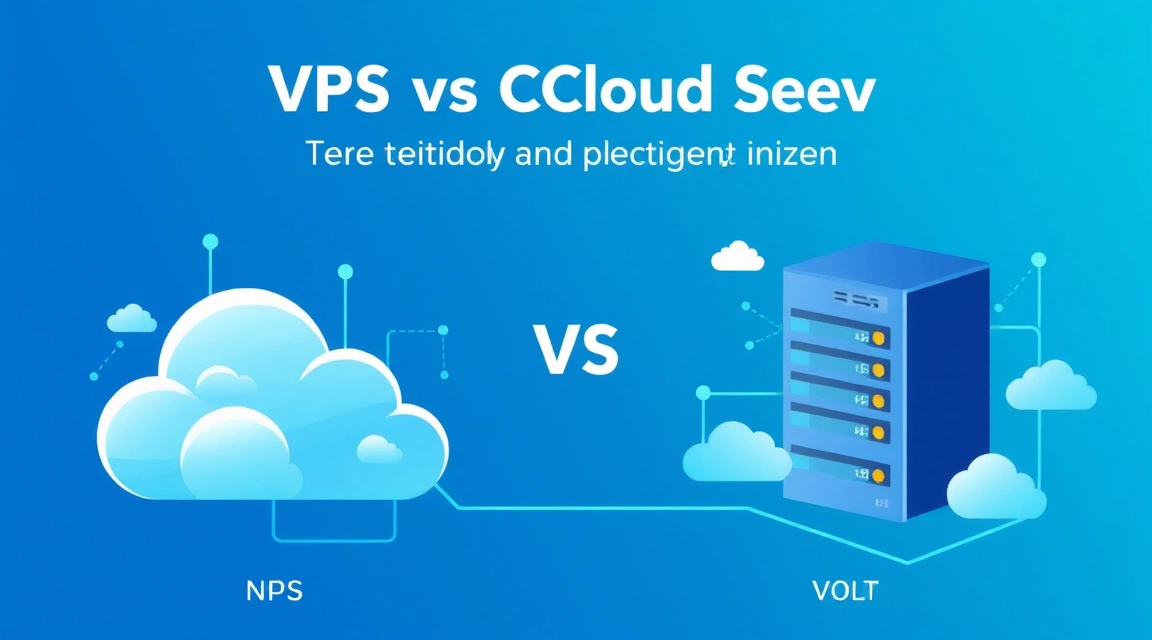
What is a cloud VPS in the technical sense of 2026
The term cloud vps is often used by marketers to describe a classic VPS running on a hypervisor (most commonly KVM) in an environment with some degree of redundancy. However, technically, the "cloud" aspect here refers to the use of network data storage (SAN) or distributed systems like Ceph. If the physical server running your VPS fails, the provider will have to manually or semi-automatically restart your machine on another node.Architecture and Resource Isolation
In 2026, the cloud vps standard implies the use of AMD EPYC Genoa or Intel Xeon Sapphire Rapids level processors. Isolation is provided at the hypervisor kernel level. It is important to understand that in budget plans, CPU resources are often "shared." This means that if a "cloud neighbor" starts consuming 100% of the power, your performance may drop. For critical tasks, it is better to study the difference between VDS and VPS to guarantee yourself dedicated CPU threads.Advantages of Local NVMe Drives
Despite the cloud trend, many Cloud VPS providers are returning to local NVMe disks in RAID 10. This provides massive I/O speeds (up to 500,000 IOPS) that are unavailable to classic distributed cloud storage due to network latency. If database speed is important for your application, a local NVMe VPS will be faster than a "true" cloud server.Cloud Server as the Evolution of Virtualization
The concept of a cloud server (or Cloud Instance) in 2026 is firmly associated with infrastructure giants (AWS, Azure, Google Cloud) and large local players. The main difference is complete abstraction from the "hardware." Your server is not tied to a specific motherboard or processor.High Availability and Failover
A true cloud server operates in a cluster with automatic Failover. If a processor node "dies," the monitoring system instantly (within seconds) migrates the RAM state and instruction execution to another free node. To the user, this looks like a brief network freeze or a reboot, but no data is lost, and no manual intervention is required. Such architecture often overlaps with concepts described in the material Bare-metal cloud vs Dedicated, where the line between physical and virtual is blurred.Scalability and API-orientation
A cloud server is always managed via API or Terraform. You can change the configuration from 2 to 32 CPU cores in 10 seconds without reinstalling the system. This is critical for projects with unpredictable traffic.Looking for a reliable server for your projects?
VPS from $10/mo and dedicated servers from $9/mo with NVMe, DDoS protection, and 24/7 support.
View offers →Difference between cloud vps and server: a detailed architectural comparison
To finally understand the difference between cloud vps and server, you need to look at three parameters: data storage, network management, and the billing model.- Data Storage: VPS more often uses local RAID. Cloud Server uses network Block Storage, which is replicated in three copies across different data center racks.
- Network: Cloud Servers implement Virtual Private Clouds (VPC), where you configure internal subnets, load balancers, and Firewalls at the infrastructure level, rather than inside the OS.
- Payment: VPS is usually paid monthly. Cloud Server is billed per second or per hour.
Comparison of SLA and Uptime Guarantees
For Cloud VPS, the standard SLA (Service Level Agreement) is 99.9%. This allows for about 9 hours of downtime per year. For a Cloud Server with a configured high-availability architecture, the SLA can reach 99.99% or even 99.999%, as the probability of an entire cluster failing simultaneously is extremely low.
Quick pick
Browse servers
Need a dedicated server?
Bare metal with NVMe in 70+ locations — configure and order in minutes.
Pricing Traps and Hidden Fees in 2026
A marketing price of $5 for a cloud server is often a bait. Unlike the fixed rates of a cloud vps, cloud giants use a complex billing system where the final bill can be an unpleasant surprise.Cost of Outbound Traffic (Egress Fees)
This is the biggest trap. Many Cloud Server providers provide inbound traffic for free but charge from $0.05 to $0.12 for every GB of outbound traffic. If your project is a media hosting service or a popular API, the cost of traffic can be 5-10 times higher than the cost of renting the server itself. In Cloud VPS, traffic is usually either unlimited (with a bandwidth limit) or included in a package (e.g., 10-20 TB), which is much more cost-effective. If you are planning a migration, study how to move from AWS Lightsail to VPS to avoid these overpayments.Paid Snapshots, Backups, and IP Addresses
In a classic cloud, you pay for everything:- Each public IPv4 address — from $3 to $5 per month.
- Snapshot storage — at a per-GB rate (often more expensive than primary disk space).
- Inter-region traffic — if the database is in one region and the server is in another.
- IOPS (input/output operations) — if you need high disk speed, you will have to pay extra for it.
Comparative Table of Characteristics and Prices 2026
Benchmarks and Performance: Cloud VPS vs Cloud Server
When testing performance in 2026, an interesting dynamic is observed. Due to the absence of network latency when accessing the disk, cloud vps with local NVMe shows better results in database tests (PostgreSQL, MySQL).
# Disk speed test (fio) on Cloud VPS (Local NVMe)
fio --name=random-write --ioengine=libaio --rw=randwrite --bs=4k --size=1g --numjobs=1 --iodepth=64 --runtime=60 --time_based --do_verify=0 --direct=1
# Result: ~350,000 IOPS

# Disk speed test (fio) on Cloud Server (Network disk)
# Result: ~15,000 - 30,000 IOPS (base level without extra payment for Performance)
Quick pick
Browse servers
Need a dedicated server?
Bare metal with NVMe in 70+ locations — configure and order in minutes.
When to Choose a Cloud Server
Despite the high price, a cloud server is indispensable in the following scenarios:- Microservices Architecture: If you use Kubernetes (K8s), cloud instances allow you to easily scale the cluster.
- Short-term Loads: Need to render a video or perform load testing? Spin up 100 servers for 2 hours and pay only for that time.
- Corporate Standards: When a business requires a 99.99% SLA and legal guarantees of data safety.
Configuration and Management via CLI
Modern providers allow you to manage infrastructure programmatically. Here is an example of what a typical instance deployment via CLI looks like in 2026 (using an abstract cloud API as an example):
# Creating a new cloud server
cloud-cli server create \
  --name production-api-01 \
  --image ubuntu-24.04-lts \
  --plan standard-2-4 \
  --region fra-01 \
  --ssh-key-id 98765

# Scaling a disk on the fly
cloud-cli volume update --id vol-12345 --size 100GB
Conclusions
For most projects in 2026, Cloud VPS is a more cost-effective solution due to fixed pricing and high local disk speeds. Choose a Cloud Server only if you strictly require automatic Failover, per-second billing, or a complex network topology with VPCs and load balancers.
SSD NVMe
Ready to launch your VPS?
NVMe VPS with 60-second activation: full root access, 20+ locations, card or crypto payments.
Choose a plan