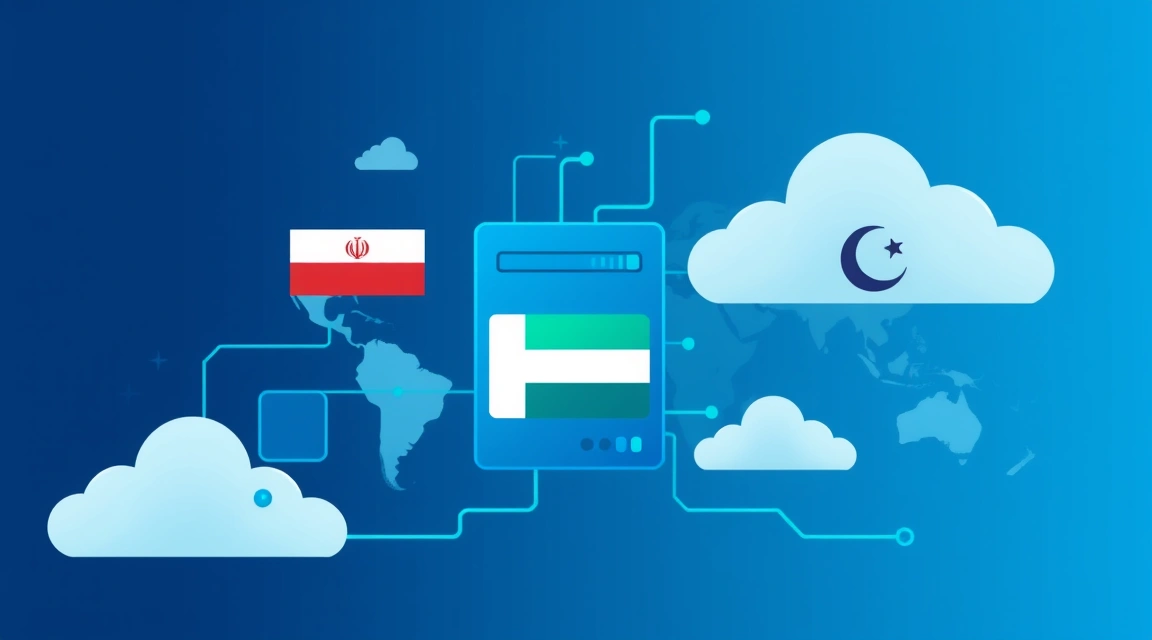
For effectively bypassing strict internet censorship and blocks in regions like Iran, Egypt, and Pakistan, an optimal **VPS for censored countries** requires a minimum of 2 vCPU, 4 GB RAM, and an NVMe disk, ideally located in nearby neutral locations (Turkey, UAE, Germany) and configured with obfuscated protocols such as VLESS/XTLS, Trojan, or Shadowsocks with plugins.
Strict internet filtering is becoming increasingly common worldwide, affecting millions of users and entire economic sectors. Countries like Iran, Egypt, and Pakistan are actively developing and deploying sophisticated Deep Packet Inspection (DPI) systems, rendering standard VPN services and even many proxy servers ineffective. This article aims to provide a deep understanding of censorship mechanisms and offer specific technical solutions for ensuring stable and secure access to information using your own VPS.
Understanding Strict Internet Censorship in Iran, Egypt, and Pakistan
Internet filtering systems in heavily censored countries are constantly evolving, becoming more sophisticated. They go far beyond simple IP address or domain name blocking, employing complex methods aimed at suppressing any circumvention attempts. Understanding these mechanisms is the first step towards developing an effective strategy. Current systems in Iran, Egypt, and Pakistan exhibit common characteristics that must be considered when choosing and configuring your own VPN on a VPS.
Whitelists and DPI: How Modern Blocks Work
Traditional blocking methods, such as IP blacklists or DNS filtering, are easily bypassed. However, modern systems, especially in Iran and Pakistan, are shifting towards a "whitelisting" concept, where only pre-approved traffic is allowed. Everything else is blocked by default. This creates significant obstacles for any unauthorized connection.
The primary tool for implementing such policies is Deep Packet Inspection (DPI) – a technology for deep packet inspection. DPI analyzes not only packet headers (like ordinary firewalls) but also their content, attempting to determine the protocol type and its compliance with established rules. For example, DPI can recognize characteristic signatures of OpenVPN or WireGuard, even if they operate on non-standard ports. If traffic does not look like regular web traffic (HTTPS), it may be slowed down, dropped, or completely blocked. This makes bypassing DPI without a VPN an extremely challenging task, requiring advanced techniques.
In Egypt, for instance, active measures are observed to block VPN protocols, and for `vps egypt bypass`, it is necessary to use obfuscated solutions that mimic legitimate HTTPS traffic. Without this, even the most powerful VPS can be useless, as its traffic will be identified and blocked at the provider level.
TLS Throttling and VPN Protocol Blocking
Another tactic employed by censors is active probing and TLS traffic throttling. When a DPI system detects a suspicious connection, it may attempt to establish its own connection to your VPS to determine what service is running there. If the server's response does not meet expectations (e.g., it's not a standard web server), the IP address may be blocked. Censors can also intentionally slow down or drop packets they identify as VPN traffic, making the connection virtually unusable.
This is particularly relevant for protocols that have clear signatures or use standard ports, such as OpenVPN, L2TP/IPSec, or even WireGuard without additional obfuscation layers. They become easy targets for automated blocking systems.
Internet Shutdowns: What to Prepare For?
The most radical measure governments resort to during periods of political instability or mass protests is a complete or partial `internet shutdown bypass`. This means cutting off internet access at the regional or national level. In such conditions, even the most advanced VPS with obfuscation becomes useless if there is no physical connection to the outside world.
While a complete shutdown is difficult to bypass technically, there are strategies that can help minimize its consequences or prepare for it: using satellite internet (if available and legal), as well as maintaining local networks and offline communication methods. However, in the context of a VPS, the main goal is to have the most resilient and inconspicuous connection during periods when the internet is still available but under strict control.
Effective Protocols and Technologies for Bypassing Censorship in 2026
In an environment of constantly tightening censorship, choosing the right protocol for bypassing blocks becomes critically important. Older methods based on simple VPN protocols have long ceased to be effective. Today's realities require the use of technologies capable of masking traffic as ordinary web connections, avoiding detection by DPI systems. This is especially relevant for `iran censorship bypass 2026` and other regions with advanced censorship.
Why Obfuscation is Mandatory
Obfuscation is the process of disguising traffic so that it appears harmless and legitimate, most often as regular HTTPS traffic. This is necessary because DPI systems don't just block known VPN ports; they analyze characteristic data patterns (signatures) to identify and block VPN protocols. If your traffic has clear signs of a VPN, it will be detected and blocked, even if you use a non-standard port.
Obfuscation works by adding an extra layer to the VPN protocol that mimics an HTTPS handshake and data transfer. This tricks DPI into thinking you are simply browsing a regular website. Without obfuscation, any VPN service in heavily censored countries will be quickly detected and blocked.
Shadowsocks, VLESS/XTLS, and Trojan: Reliable Solutions
Currently, the most effective protocols for bypassing strict censorship are those that are inherently designed with obfuscation in mind or have powerful masking mechanisms:
- Shadowsocks: This is a proxy protocol originally created to bypass the Great Firewall of China. It uses SOCKS5 proxy with encryption, but its key feature is the ability to use obfuscation plugins such as
v2ray-plugin,simple-obfs, orkcptun. These plugins allow Shadowsocks traffic to be masked as HTTPS, WebSocket, or other protocols, making it virtually indistinguishable from regular web traffic for DPI. Shadowsocks-2022 on a VPS with properly configured plugins remains one of the most reliable solutions. - VLESS/XTLS: The VLESS protocol is part of the Xray/V2Ray ecosystem and is a flexible, high-performance protocol without its own encryption (relying on TLS). In conjunction with XTLS, it provides effective obfuscation, masking traffic as HTTPS. XTLS uses TLS as the transport layer but optimizes the process, minimizing overhead and ensuring high performance. Its ability to mimic real HTTPS traffic makes it extremely resilient to DPI.
- Trojan: This protocol is specifically designed to imitate HTTPS. It establishes a direct TLS connection to the server using certificates and transmits data through it. To DPI, Trojan traffic looks like a regular HTTPS connection to a web server. This makes it very effective against systems that look for characteristic VPN signatures. Trojan often uses port 443, standard for HTTPS, which further helps it blend into the background.
These protocols, especially when combined with TLS encryption and obfuscation, demonstrate high resilience to DPI and active probing, making them the best choice for `vps for censored countries`.
WireGuard and OpenVPN: When They Fall Short
Despite their popularity and excellent performance in normal conditions, OpenVPN and WireGuard often prove ineffective against advanced DPI systems:
- OpenVPN: Although OpenVPN can operate over TCP port 443, its handshake and packet structure have unique signatures that DPI can easily detect. Even using obfuscation plugins (e.g.,
obfsproxy) does not always provide sufficient protection in the harshest conditions, as DPI becomes increasingly intelligent. Its performance can also be lower than that of more modern protocols. - WireGuard: WireGuard is a modern, fast, and cryptographically secure VPN protocol. However, it lacks built-in obfuscation mechanisms. Its UDP traffic is easily identified by DPI, especially if it operates on non-standard ports. There are attempts to obfuscate WireGuard using UDP over TCP or other tunnels, but these solutions complicate setup and can reduce performance, while not always guaranteeing complete invisibility. For `vps pakistan vpn`, WireGuard by itself, without additional layers of protection, will likely be quickly blocked.
Therefore, when choosing a solution for heavily censored regions, preference should be given to protocols that were specifically designed with obfuscation and HTTPS masquerading in mind.
Looking for a reliable server for your projects?
VPS from $10/month and dedicated servers from $9/month with NVMe, DDoS protection, and 24/7 support.
View Offers →Choosing the Right VPS for Censored Countries: Locations and Configurations
Choosing the right VPS server for censorship circumvention involves not only protocols but also strategically important factors: the server's geographical location and its technical specifications. These aspects directly influence the speed, stability, and resilience of your connection.
Optimal Locations: Turkey, UAE, Europe
The geographical location of your VPS plays a key role for several reasons:
- Low latency: The closer the server is to the end-user, the lower the latency. For users in Iran, Egypt, and Pakistan, this means that servers in neighboring or nearby European countries, as well as in Turkey and the UAE, will be preferable.
- Turkey: An excellent choice for Iran and parts of Pakistan. Geographical proximity ensures minimal latency. However, it's worth noting that Turkish providers may be subject to political pressure, so choose trusted hosts.
- UAE (Dubai): A good option for the Middle East and Pakistan. Dubai is a major hub, providing excellent connectivity. Although the UAE itself has certain internet restrictions, hosting providers there are usually neutral regarding traffic on their VPS.
- Eastern and Central Europe (Germany, Netherlands, Finland): A versatile and reliable choice. These countries are known for their strong privacy laws, high-quality infrastructure, and excellent global connectivity. Latency may be slightly higher than in Turkey or the UAE, but reliability often compensates for this. For VPS for bypassing blocks in Iran, European locations often prove more stable in the long run.
- Network connectivity (peering): It is important that the hosting provider has good peering agreements with major backbone operators that carry traffic to the target regions. This ensures that traffic takes optimal routes.
- Political neutrality: Choosing a country with strong privacy laws and minimal political pressure on hosting providers reduces the risk of your server being suddenly blocked at the request of third parties.
Resource Requirements: vCPU, RAM, Disk
Minimum VPS requirements for censorship circumvention are usually not high, but depend on the number of concurrent users and traffic intensity:
- vCPU (virtual CPU cores): For 1-5 users, 1 vCPU is sufficient. For 5-20 users or intensive use (streaming, torrents), 2 vCPU are recommended. If you plan to serve a larger group or use resource-intensive protocols, 4 vCPU will be optimal.
- RAM (Random Access Memory): 1-2 GB RAM is the minimum for stable operation of most obfuscated protocols. For 5-10 users, it's better to choose 4 GB RAM. If you plan to run multiple protocols simultaneously or anticipate peak loads, 8 GB RAM will provide maximum stability.
- Disk: 20-40 GB of disk space is sufficient for the operating system and configuration files. The disk type is more important: NVMe or SSD significantly outperform traditional HDDs in read/write speeds, which is critical for server performance and handling a large number of small packets. NVMe is highly recommended.
- Network port: A minimum of 100 Mbps bandwidth is required, but a 1 Gbps (gigabit) port is preferable, especially if you plan to share access or use the VPS for streaming. Ensure that the provider offers sufficient monthly traffic or unlimited traffic.
When choosing a VPS, always anticipate potential load growth and preferably select a plan with a small reserve of resources.

Practical Strategy: Redundant VPS Configurations and Quick Switching
In conditions of unpredictable and aggressive internet blocking, one of the most reliable strategies is to create redundancy. This means that instead of a single point of failure (one VPS server), you deploy two or more independent configurations. This approach significantly increases your resilience to IP address or entire data center blocks.
Backup Channel in Case of Main IP Blockage
The most common problem when using a VPS for censorship circumvention is the blocking of your server's IP address. Censors actively scan the internet, looking for known VPN signatures and blocking suspicious IPs. If your only VPS is blocked, you will be left without access.
Solution: Deploy at least two VPS in different geographical locations and, if possible, with different hosting providers. For example, one VPS in Germany, the other in Turkey. On each VPS, configure one or more obfuscated protocols (e.g., VLESS/XTLS on one and Shadowsocks + v2ray-plugin on the other).
Advantages of this approach:
- Geographical diversification: If a provider in one country starts blocking traffic in a certain direction, you have an alternative route through another country.
- Provider diversification: Different hosting providers use different IP address ranges. Blocking one range will not affect another.
- Protocol diversification: If one protocol is detected and blocked, you have a backup option with a different protocol that may be more resilient to new DPI methods.
Thus, one VPS acts as the primary channel, and the second as a backup. If the primary IP is blocked, you quickly switch to the backup.
Setting Up Switching and Automation
Manually switching between VPS servers can be inconvenient. To ensure a quick and seamless transition, there are several approaches:
- Client applications with multiple profiles: Most modern VPN/proxy clients (e.g., V2RayN, Nekoray, Clash on Windows/Android, Streisand on iOS) allow you to configure multiple connection profiles. You can create profiles for each of your VPS and easily switch between them if necessary.
- Using DNS records for dynamic IP: If you use a domain name for your VPS (which is highly recommended for obfuscation via TLS), you can configure DNS records to point to your active IP address. In case of a primary IP block, you change the DNS record to point to the backup IP. This requires some time for DNS propagation (TTL), but can be effective. For faster switching, you can use services like Cloudflare Zero Trust, where multiple origins can be configured for a single domain.
- Automated scripts (for advanced users): You can write a script that periodically checks the availability of the primary VPS (e.g., pings it or tries to establish a connection) and, if unavailable, automatically switches the client to the backup server or updates the DNS record. This requires certain system administration skills.
Example of a simple availability check (on a Linux client):
#!/bin/bash
PRIMARY_IP="your_primary_vps_ip"
SECONDARY_IP="your_secondary_vps_ip"
CONFIG_FILE="/path/to/your/client_config.json"

if ! ping -c 1 -W 1 $PRIMARY_IP &> /dev/null; then
    echo "Primary VPS is unreachable. Switching to secondary."
    # Здесь логика для изменения клиентского конфига или перезапуска сервиса
    # Например, если используете v2ray/xray, можете изменить 'address' в конфиге
    # sed -i "s/\"address\": \".*\"/\"address\": \"$SECONDARY_IP\"/" $CONFIG_FILE
    # systemctl restart xray # или ваш сервис
else
    echo "Primary VPS is reachable."
fi
This strategy minimizes downtime and provides the highest possible resilience to blocks, which is critically important for `vps for censored countries`.
Comparing VPS Configurations for Bypassing Censorship
For 10-20 concurrent users, 2 vCPU, 4 GB RAM, and a 40 GB NVMe disk are sufficient.
| Number of Users | vCPU | RAM | Disk | Port | Approx. Price ($/month) |
|---|---|---|---|---|---|
| 1-5 (light usage) | 1 | 1-2 GB | 20 GB NVMe/SSD | 100 Mbps | $3-7 |
| 5-10 (moderate usage) | 2 | 2-4 GB | 40 GB NVMe/SSD | 1 Gbps | $7-15 |
| 10-20 (active usage, streaming) | 2-4 | 4-8 GB | 60-80 GB NVMe | 1 Gbps | $15-30 |
| 20-50 (intensive usage, multiple services) | 4-6 | 8-16 GB | 80-160 GB NVMe | 1 Gbps | $30-60+ |
Setup and Security Recommendations for Your Censorship-Bypassing VPS
After choosing the right VPS and protocols, proper configuration and adherence to security measures are the final, but no less important, steps to ensure stable and secure circumvention of blocks.
- Use a domain name and SSL certificates: For obfuscation under HTTPS, it is crucial to use a domain name (even a very cheap one, e.g., from Freenom) and a valid SSL certificate (e.g., free from Let's Encrypt). This will help your traffic appear as a regular web connection and significantly reduce the chances of DPI detection.
- Choose non-standard ports (with caution): While obfuscation is more important than the port, sometimes using non-standard ports (other than 443 for HTTPS obfuscation) can help avoid simple blocks. However, for protocols masquerading as HTTPS, port 443 is mandatory.
- Regularly update software: Update the VPS operating system, as well as the client and server parts of your proxy protocols. Developers constantly release patches and improvements that enhance resilience to blocks and fix vulnerabilities.
- Restrict VPS access:
- Use SSH keys instead of passwords for server access.
- Disable password login for the root user.
- Change the standard SSH port (22) to another.
- Configure a firewall (e.g., UFW on Ubuntu) to allow access only to necessary ports (SSH, your proxy/VPN port).
- Use a CDN for masking: In some cases, especially for `vps for china censorship bypass what works against gfw in 2026` and other countries with aggressive firewalls, CDN services (e.g., Cloudflare) can be used to proxy traffic to your VPS. This helps hide the real IP address of your server and adds another layer of obfuscation.
- Monitoring and logging: Regularly check your VPS and proxy server logs for suspicious activity or scanning attempts. This will help you promptly respond to potential threats or blocks.
- Do not use public IP addresses: If you have the option to use IP addresses that are not on the censors' "blacklists" (e.g., new IP addresses that have not yet been used for VPNs), this can give you some advantage.
- Be prepared to change IP: Some providers offer the option to change the server's IP address for a small fee. If your IP is blocked, this can be a quick solution.
Frequently Asked Questions
Here we have compiled answers to the most common questions regarding the use of a VPS for censorship circumvention.
Which protocol is best for bypassing censorship in Iran?
For bypassing censorship in Iran, protocols with strong obfuscation, such as VLESS/XTLS, Trojan, or Shadowsocks with plugins (e.g., v2ray-plugin or simple-obfs), are best. These protocols mask traffic as regular HTTPS, which helps them evade detection by DPI systems. It is recommended to use port 443 and a domain name with a valid SSL certificate.
How much does a VPS for bypassing blocks cost?
The cost of a VPS for bypassing blocks starts at approximately $3-7 per month for a basic configuration (1 vCPU, 1-2 GB RAM, 20 GB NVMe). For a more stable connection and multiple users, a plan for $7-15 per month, offering 2 vCPU, 4 GB RAM, and a 40 GB NVMe disk, is recommended. Prices depend on location and provider.
Do I need a dedicated IP address for a VPS?
Yes, for a VPS used for bypassing blocks, a dedicated IP address is always needed. Most VPS plans include one dedicated IPv4 address by default. Using a shared IP address (which is rare for VPS) significantly increases the risk of blocking, as other users may use it for undesirable traffic.
Can free VPN services be used to bypass censorship?
It is strongly not recommended to use free VPN services to bypass strict censorship. They often have low bandwidth, are overloaded, use outdated protocols, are easily blocked, and may collect your data. For reliable and secure access to information, it is always better to use your own VPS with proven obfuscated protocols.
How often are VPS IP addresses blocked in censored countries?
The frequency of VPS IP address blocks varies greatly. During periods of increased censorship or mass protests, IP addresses can be blocked daily or even hourly. During calmer times, an IP may work for weeks or months. This is why it is recommended to have multiple VPS and set up backup channels to be prepared for frequent blocks.
Conclusion
For successfully bypassing strict internet censorship in Iran, Egypt, and Pakistan, a strategic approach is critical, including choosing a reliable VPS, using obfuscated protocols, and creating redundancy. Investing in your own VPS with 2-4 vCPU, 4-8 GB RAM, and an NVMe disk, located in Turkey, the UAE, or Europe, combined with protocols like VLESS/XTLS, Trojan, or Shadowsocks with plugins, will ensure maximum resilience. Always prepare a backup channel and stay informed about current recommendations to maintain access to a free internet.
NVMe VPS with 60-second activation: full root access, 20+ locations, card or crypto payments.
Choose a plan