The demand for Graphics Processing Unit (GPU) computing power is rapidly growing, especially in the fields of artificial intelligence, machine learning, rendering, and scientific computing. However, purchasing and maintaining proprietary GPU farms remains an unbearable burden for many startups, researchers, and even large companies. This is why GPU rental services have become a cornerstone of modern IT infrastructure.
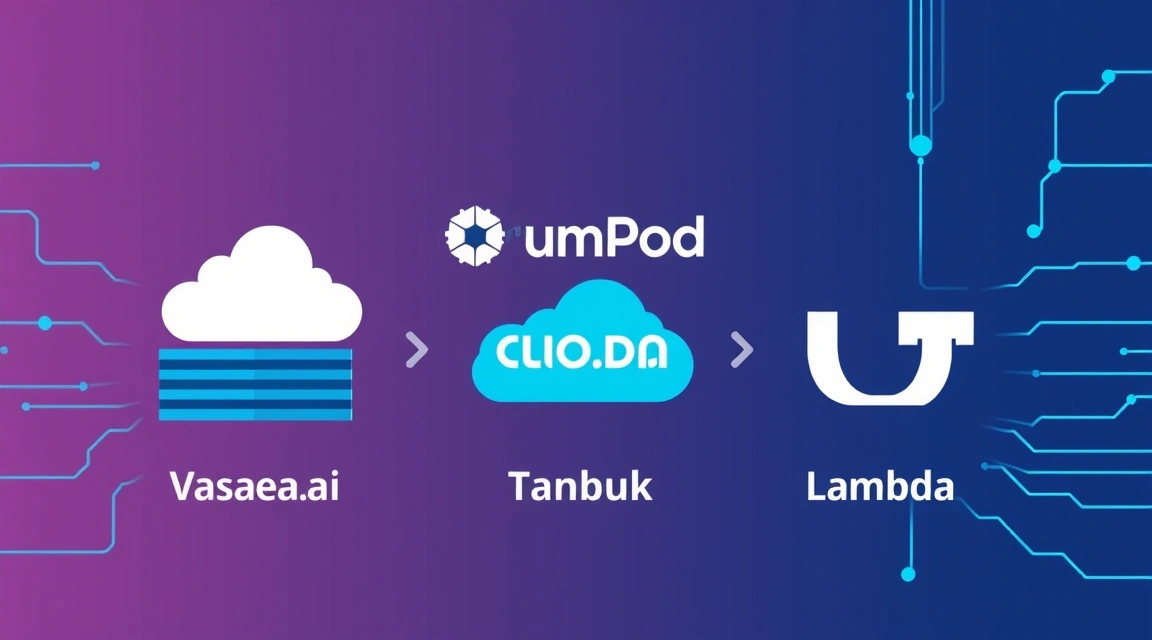
There are many providers in the market, but three of them — Vast.ai, RunPod, and Lambda Labs — often stand out, offering different approaches to GPU rental. In this article, we will conduct an in-depth analysis of their offerings, find out where it's truly cheaper to rent a GPU in 2026, examine the reliability and availability of cards, uncover hidden costs, and provide specific recommendations on which platform suits whom.
Vast.ai: Is it Really the Cheapest GPU Rental and What Are the Risks? (vast.ai review)
Vast.ai positions itself as a cheap GPU rental aggregator, operating on the principle of a decentralized marketplace. This means that you rent GPUs not directly from Vast.ai, but from thousands of individual providers worldwide who lease out their idle graphics cards. This model allows for unprecedentedly low prices, but with certain trade-offs.
Vast.ai Operating Model and Equipment Sources
The essence of Vast.ai is that any GPU owner can register as a host and rent out their cards to other users. Vast.ai acts as an intermediary, providing a platform for finding, booking, and managing instances. Hosts can range from individuals with one or two cards to small mining farms that have reoriented towards AI computing. This explains the huge variety of available configurations, from budget RTX 3060s to powerful H100s, and most importantly, extremely dynamic pricing.
The platform offers both On-Demand and Interruptible (Spot) instances. Spot instances are significantly cheaper but can be interrupted by the host at any time if they decide to use the GPU for themselves or if another user offers a higher price. This makes them ideal for tasks that can be easily resumed or are designed for short sessions, such as inference or testing small models.
Vast.ai uses Docker containers to launch instances, providing high flexibility in environment setup. You can choose pre-built images with pre-installed frameworks (TensorFlow, PyTorch) or create your own. This is convenient for developers who need full control over their stack.
Vast.ai Pricing and Pitfalls
Prices on Vast.ai can be 50-80% lower than traditional cloud providers. For example, renting an NVIDIA RTX 4090 can cost from $0.20-$0.30 per hour, and an A100 from $0.80-$1.50 per hour, depending on availability, region, and current demand. The H100, being rarer, will cost more, but still competitively.
However, a low price does not mean an absence of risks. The main pitfalls of Vast.ai include:
- Host Unpredictability: The quality of equipment, internet connection stability, and the reliability of the host itself can vary greatly. An instance might suddenly go down due to power issues, overheating, or simply because the host decided to turn it off.
- Availability: Despite the abundance of offers, finding a specific GPU configuration (e.g., several H100s with NVLink) in the desired region and at a low price can be challenging. The market is very dynamic.
- Support: Vast.ai support is focused on the platform, not on individual instances. If you have problems with a specific host, you'll have to resolve them yourself or find another instance.
- Hidden Costs: While base rates are low, it's worth considering storage costs (typically $0.05-$0.10 per GB/month) and network traffic (though often enough is included for most tasks).
Example of searching for an instance on Vast.ai:
# Example of filtering via CLI (or web interface)
vast search instances --gpu_name "RTX 4090" --min_vram 24 --min_cpu 8 --min_ram 64 --disk_space 200 --order_by "dph" --order "asc"
This will allow you to find the cheapest RTX 4090s with specific parameters. It's important to carefully read host reviews and check their rating before renting.
RunPod: Balance Between Price and Reliability (runpod vs lambda)
RunPod occupies an intermediate position between Vast.ai's decentralized marketplace and Lambda Labs' premium offerings. It provides a more stable infrastructure than Vast.ai while maintaining competitive prices, especially for Spot instances. This makes it an attractive choice for those looking for reliable `cheap GPU rental` without the extreme risks of Vast.ai.
On-Demand and Spot Instances: Flexibility and Risks
RunPod offers two main types of instances:
- On-Demand: These are guaranteed instances with predictable performance and uptime. Prices are higher than Spot, but you get the stability needed for long model training sessions or critical tasks.
- Spot: Similar to Vast.ai, Spot instances on RunPod are significantly cheaper. They can be interrupted, but the interruption policy is usually more transparent than on Vast.ai, and you often receive advance notice. RunPod's Spot market also consists of equipment from various providers, but with stricter quality control from the platform.
RunPod frequently updates its GPU fleet, offering a wide range of cards, including A100, H100, and RTX 4090. The availability of powerful cards here is higher than on Vast.ai, especially for On-Demand instances. You can also find configurations with NVLink for scaling performance across multiple GPUs.
Instance management is done via a web interface or API. RunPod provides ready-made Docker image templates for popular ML frameworks and the ability to upload your own images. This makes the deployment process fast and convenient.
RunPod Infrastructure and Support Features
RunPod's infrastructure is more centralized compared to Vast.ai, which positively impacts reliability. They actively work to ensure stable connectivity and performance. However, since part of their Spot infrastructure also relies on third-party hosts, completely eliminating the risks of interruptions or hardware issues is not possible.
RunPod's pricing is transparent. For example, an RTX 4090 in On-Demand mode can cost from $0.60-$0.80 per hour, and in Spot mode from $0.30-$0.50. An A100 will cost from $1.50-$2.50 On-Demand and from $0.90-$1.80 Spot. An H100 typically starts from $3.00-$4.00 On-Demand and $2.00-$3.00 Spot. These prices make RunPod very competitive for many projects.
RunPod actively develops its ecosystem, offering additional services such as Persistent Storage, Network Volumes, and the ability to create private clouds. This is especially important for projects requiring long-term data storage and fast migration between instances. Customer support at RunPod is generally more responsive than at Vast.ai and capable of resolving a wider range of issues.
Example of launching an instance on RunPod via API:
curl -X POST \
  https://api.runpod.io/v2/user/pods \
  -H "Authorization: Bearer YOUR_API_KEY" \
  -H "Content-Type: application/json" \
  -d '{
    "gpuType": "NVIDIA GeForce RTX 4090",
    "cloudType": "SECURE_CLOUD",
    "imageName": "runpod/pytorch:2.0.1-py3.10-cuda11.8.0",
    "volumeInGb": 100,
    "minDiskInGb": 50,
    "containerDiskInGb": 20,
    "ports": "8888/http",
    "env": {
      "JUPYTER_PASSWORD": "your_password"
    }
  }'
This request will create an On-Demand instance with an RTX 4090 and configure Jupyter Notebook.
Looking for a reliable server for your projects?
VPS from $10/month and dedicated servers from $9/month with NVMe, DDoS protection, and 24/7 support.
View offers →Lambda Labs: Premium Class for Demanding Tasks
Lambda Labs targets the enterprise segment and researchers who require maximum reliability, performance, and predictability. It is a cloud provider in the classic sense, managing its own data centers and providing dedicated GPU resources. The price here is higher, but in return, you get guarantees that Vast.ai or even RunPod on Spot instances cannot offer.
Lambda Labs Guarantees of Availability and Performance
A key advantage of Lambda Labs is guaranteed access to high-performance GPUs, such as A100 and H100, in large quantities. If you need to train a complex model on an 8x H100 cluster with NVLink for several weeks without interruptions, Lambda Labs is one of the best options. They offer:
- Dedicated Resources: You get exclusive access to selected GPUs, without the risk of interruptions or performance degradation due to other users.
- High-Speed Interconnect: For multi-GPU configurations (especially with A100 and H100), NVLink or NVSwitch is critically important. Lambda Labs ensures optimal topology for maximum bandwidth.
- Reliable Infrastructure: Modern data centers with redundant power, cooling, and network channels minimize downtime risks.
- Professional Support: The Lambda Labs team specializes in AI infrastructure and can assist with optimizing, debugging, and scaling your workloads.
While Lambda Labs does not offer the RTX 4090 as a primary rental product, their focus on A100 and H100 makes them a leader for the most demanding AI tasks. They also offer their own systems, such as Lambda Hyperplane, for creating private AI clouds.
Lambda Labs Pricing Policy and Who It Suits
Prices at Lambda Labs are predictably higher than competitors. For example, an A100 80GB can cost from $2.50-$3.50 per hour, and an H100 80GB from $5.00-$7.00 and up, depending on the configuration (number of GPUs, NVLink presence) and rental duration. They may also offer discounts for long-term contracts or reserved instances.
Lambda Labs prices may seem high, but they are justified for the following scenarios:
- Critical Production Workloads: Where system downtime means direct financial losses.
- Long Model Training Sessions: Which can take days or weeks, and whose interruption means loss of progress and time.
- Demanding Research: Where maximum performance and stability are needed to obtain accurate results.
- Large GPU Clusters: When synchronized operation of tens or hundreds of GPUs is required.
Lambda Labs also offers a wide selection of pre-installed Docker images optimized for AI/ML, and the ability to use custom images. They integrate with popular orchestration and monitoring systems, simplifying the management of large-scale deployments.

Comparing A100, H100, and RTX 4090 Prices: Where to Find the Optimal `GPU Rental Comparison`?
To get a complete picture, it's necessary to compare specific GPU models, as prices and availability heavily depend on the generation and characteristics of the card. We will focus on three key models relevant for 2026: NVIDIA RTX 4090, NVIDIA A100, and NVIDIA H100.
GPU Price and Availability Table in 2026
The prices listed are indicative and may vary depending on current demand, region, server configuration (CPU, RAM, storage), and instance type (On-Demand/Spot). A price range is indicated for Vast.ai, as their prices are the most volatile.
| GPU Model | Specifications | Vast.ai (Spot/On-Demand, $/hour) | RunPod (Spot/On-Demand, $/hour) | Lambda Labs (On-Demand, $/hour) |
|---|---|---|---|---|
| NVIDIA RTX 4090 | 24GB GDDR6X, 128 SMs, 384-bit bus, ~83 TFLOPS FP32 | $0.20 - $0.50 | $0.30 - $0.80 | Not a primary product |
| NVIDIA A100 (40GB) | 40GB HBM2, 108 SMs, 5120-bit bus, ~19.5 TFLOPS FP64, ~156 TFLOPS FP32 (TF32) | $0.80 - $1.50 | $1.50 - $2.50 | $2.50 - $3.50 |
| NVIDIA A100 (80GB) | 80GB HBM2, 108 SMs, 5120-bit bus, ~19.5 TFLOPS FP64, ~156 TFLOPS FP32 (TF32) | $1.20 - $2.00 | $2.00 - $3.00 | $3.00 - $4.00 |
| NVIDIA H100 (80GB) | 80GB HBM3, 114 SMs, 5120-bit bus, ~33.5 TFLOPS FP64, ~66 TFLOPS FP32, ~989 TFLOPS FP8 | $2.50 - $4.00 | $3.00 - $5.00 | $5.00 - $7.00+ |
The RTX 4090 remains a leader in price/performance ratio for many tasks not requiring FP64 or huge amounts of VRAM, especially for inference, fine-tuning small models, and graphics work. It is most available on Vast.ai and RunPod.
The A100 (especially the 80GB version) is an industry standard for training large models. Its Tensor Cores and high memory bandwidth make it ideal for complex AI projects. A100s can be found with all three providers, but with varying degrees of reliability and price.
The H100 is NVIDIA's flagship, offering unprecedented performance for the most demanding AI tasks, especially with FP8 and Transformer Engine. It is the most expensive and least available, but for cutting-edge research and massive models, its advantages are undeniable. For better availability and guaranteed H100 performance, RunPod (On-Demand) and Lambda Labs are the go-to options.
Factors Affecting the Final Cost
In addition to the hourly GPU rate, several factors influence the final rental cost:
- CPU and RAM: The choice of CPU (number of cores, frequency) and amount of Random Access Memory (RAM) for your instance. Often, training models requires a powerful CPU for data preprocessing.
- Storage: The cost of persistent storage (SSD/NVMe) per gigabyte per month. This is critical for large datasets and saving model checkpoints.
- Network Traffic: Charges for egress bandwidth. Ingress traffic is usually free. For large models and distributed computing, this can become a significant expense.
- Additional Services: VPN, static IP addresses, load balancers, managed databases, etc.
- Idle Time: Some providers may charge for an instance even if it's not being used but is running. Always stop instances when they are not needed to save money.
- Software: Licenses for proprietary software, if not included in the base image.
When choosing a provider, always carefully examine the full pricing structure to avoid surprises.
Hidden Costs and Non-Obvious Factors When Choosing GPU Hosting
When evaluating `cheap GPU rental`, it's important to look beyond just the hourly GPU rate. There are non-obvious factors and hidden costs that can significantly increase the total cost and impact the efficiency of your work.
Traffic, Storage, and Idle Time
- Network Traffic (Egress Bandwidth): This is one of the most insidious hidden costs. Most providers include a certain amount of inbound traffic for free, but outbound traffic (when you download training results, logs, or models) is charged. Prices range from $0.05 to $0.15 per gigabyte. If you frequently work with large datasets or models that need to be uploaded and downloaded, these costs can quickly accumulate. Vast.ai and RunPod usually have a basic free limit, but for Lambda Labs, as with other large cloud providers, this can be a significant portion of the bill.
- Storage:
- System Disk: The disk where the OS and Docker image are installed. Its size is usually fixed and included in the instance cost.
- Persistent Storage/Volumes: This is a separate disk that can be attached and detached from instances. It is charged per gigabyte per month (e.g., $0.05-$0.15/GB/month). This is critical for saving your data, code, and model checkpoints to avoid losing them when an instance is deleted. Vast.ai and RunPod offer such options.
- Snapshots/Backups: Creating copies of your data or images may also be charged.
Keep in mind that on Vast.ai, the quality and speed of storage can heavily depend on the host, whereas on RunPod and Lambda Labs, it is usually more standardized and performant (NVMe SSD).
- Idle Time: If you've launched an instance but are not using it, it still consumes resources (CPU, RAM, GPU) and you are charged for it. Some platforms have automatic shutdown features for inactivity, but not all. Always ensure you stop or delete instances when they are not needed to avoid unnecessary costs. On Vast.ai, this is especially important, as an instance may only become available to others after you disconnect.
Ease of Use and Support: What Costs Money?
While not directly reflected in the hourly rate, the quality of the platform and support can impact your overall productivity and project cost:
- Setup Complexity: Vast.ai requires a deeper understanding of Docker and Linux, as well as skills in debugging host-related issues. RunPod and Lambda Labs offer more intuitive interfaces and ready-made solutions, saving developer time.
- Quality of Support:
- Vast.ai: Support is primarily via community and basic documentation. If a problem is related to a specific host, a solution might take a long time or not be found at all.
- RunPod: More responsive technical support, capable of assisting with platform issues and general inquiries.
- Lambda Labs: Premium support, often with dedicated engineers who can assist with in-depth debugging and optimization of AI workloads. This is especially valuable for large projects.
- Monitoring Tools: The presence of built-in monitoring tools (GPU, CPU, RAM usage, temperatures) helps to timely identify problems and optimize resources. All three platforms offer basic monitoring, but Lambda Labs may have more advanced options.
- Ecosystem: Integration with other services (e.g., MLOps platforms, CI/CD) can simplify workflows. Lambda Labs and RunPod actively develop their ecosystems, while Vast.ai is more "raw" in this regard.
- Instance Persistence: On Vast.ai, you might encounter a situation where a cheap instance you found disappears after a reboot or a few hours. This forces you to spend time searching for a new one and transferring data. On RunPod (On-Demand) and Lambda Labs, instances are more stable.
For projects where developer time is expensive and stability is critical, a higher hourly rate on RunPod or Lambda Labs might ultimately be cheaper than constant downtime and debugging on Vast.ai.
For example, if you need a stable VPS to host your ML service, where the GPU is used for 24/7 inference, it's worth considering reliable platforms rather than just seeking the lowest price. Vultr or DigitalOcean, while not specializing in GPUs, can offer more predictable conditions for general hosting if the GPU workload is not dominant.
Who Suits What: Choosing a Platform for Your Task (vast ai vs runpod)
The choice between Vast.ai, RunPod, and Lambda Labs depends on your specific needs, budget, risk tolerance, and stability requirements. There is no universal "best" solution; there is an optimal one for your situation.
For Startups, Experiments, and Limited Budgets
If your project is in the prototyping or testing phase, you have a very limited budget, or your tasks are not uptime-critical and can be easily resumed, then:
- Vast.ai: Your primary choice for
cheap GPU rental.- Ideal for:
- Short experiments and hypothesis testing.
- Model inference that can be quickly restarted.
- Fine-tuning small models where loss of progress is not critical.
- Student projects and personal research.
- Finding the lowest prices for specific GPUs (e.g.,
vast ai vs runpodin terms of price).
- When to use: When you are willing to spend time searching for a suitable host, monitoring the instance, and are prepared for possible interruptions. You have experience with Docker and Linux for quick environment setup.
- Recommendation: Always use persistent storage for data and checkpoints to minimize losses during interruptions.
- Ideal for:
- RunPod (Spot instances): An excellent compromise between Vast.ai's price and reliability.
- Ideal for:
- Training moderately complex models where you want to save money but get a more predictable environment.
- Tasks that can be periodically interrupted, but with less risk than on Vast.ai.
- Research where you need access to a wider range of GPUs, including A100/H100, at a reduced price.
- When to use: When you want to save money but value a more stable infrastructure and better support compared to Vast.ai. You are prepared for potential interruptions but expect them to be rarer and more predictable.
- Ideal for:
For Production Workloads, Critical Projects, and Large Companies
If your project requires maximum stability, guaranteed performance, high-speed interconnect for multi-GPU configurations, and you cannot afford downtime, then more expensive but reliable solutions will be justified.
- RunPod (On-Demand instances): A good choice for balancing price and stability.
- Ideal for:
- Long model training sessions where interruptions are undesirable.
- Production inference requiring stable uptime.
- Development and testing where a predictable environment is needed.
- When a
GPU rental comparisonis needed, and RunPod offers the best balance of price and On-Demand quality.
- When to use: When you need guaranteed GPU availability, but your budget does not allow for the Lambda Labs level. You value RunPod's flexibility and its ecosystem.
- Ideal for:
- Lambda Labs: A premium solution for the most demanding AI tasks.
- Ideal for:
- Large-scale training of state-of-the-art models on A100/H100 clusters.
- Enterprise projects where SLA (Service Level Agreement) and professional support are critically important.
- Scientific research requiring guaranteed access to powerful GPUs in large quantities.
- Projects with strict deadlines where downtime is unacceptable.
- When to use: When the budget allows, and you are not willing to compromise on reliability and performance. You are looking not just for a
GPU rental comparison, but a comprehensive solution with full support.
- Ideal for:
Ultimately, choosing a platform is a strategic decision that should be based on a deep understanding of your needs, risks, and the capabilities of each. Start with Vast.ai for the most budget-conscious experiments, move to RunPod for more serious but still price-sensitive tasks, and opt for Lambda Labs when stability and performance become the number one priority.
Conclusion
In 2026, Vast.ai remains the cheapest option for GPU rental, offering unprecedentedly low prices but with a high risk of instability and lack of guarantees. RunPod is the golden mean, providing more reliable On-Demand instances and competitive Spot prices, while Lambda Labs is geared towards enterprise clients, offering premium stability and performance for critical AI tasks at a corresponding price. For most developers and startups seeking a balance between cost and reliability, RunPod (especially its On-Demand offerings) will be the optimal choice, while Vast.ai is ideal for high-risk, budget-conscious experiments, and Lambda Labs for uncompromising production workloads.
Bare metal in 70+ locations: modern hardware, NVMe, fast provisioning, card or crypto payments.
Browse servers