10 Most Popular Cloud Infrastructure Management Applications
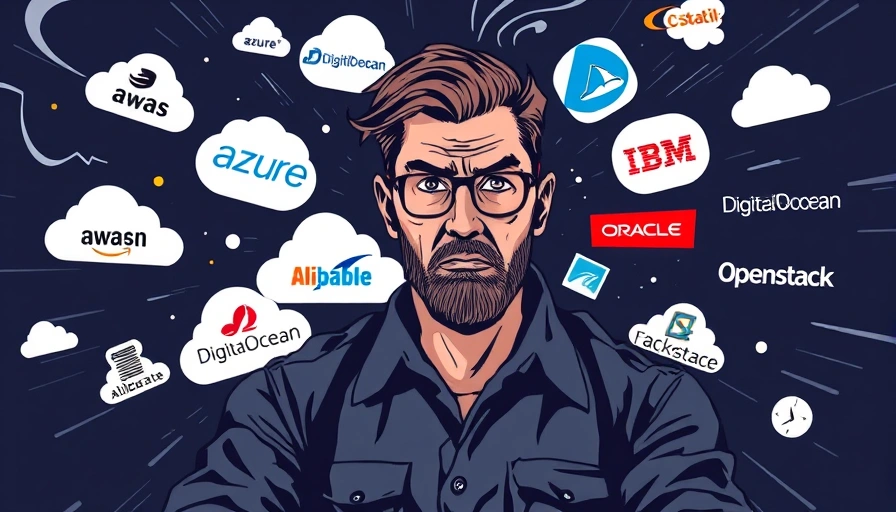
In a world where clouds have become the de facto standard, effective infrastructure management is not just a desirable option, but a critical necessity. Choosing the right tools for this task can significantly simplify the lives of system administrators, reduce operational costs, and increase system reliability. Today, we will look at ten of the most popular and in-demand platforms and applications that help professionals manage cloud resources: Amazon Web Services (AWS), Microsoft Azure, Google Cloud Platform (GCP), IBM Cloud, Oracle Cloud Infrastructure (OCI), VMware Cloud on AWS, DigitalOcean, Alibaba Cloud, Rackspace, and OpenStack. Each of them has its own features, strengths, and use cases, which we will analyze in detail so that you can make an informed choice for your projects or company.Why do system administrators need powerful cloud management tools?
 For us, system administrators, the cloud is not just remote servers, but a complex, dynamically evolving ecosystem that requires constant attention. Manually managing hundreds or thousands of resources is an unrealistic task. This is where specialized management applications and platforms come to the rescue. They allow you to:
- Automate routine tasks: Deployment, scaling, monitoring, and updating resources become programmatic operations.
- Control costs: Cloud billing can be tricky. Tools help track consumption, prevent surprises, and optimize costs.
- Enhance security: Centralized identity and access management (IAM), configurations, and policies reduce risks and simplify auditing.
- Ensure compliance: Compliance with regulatory requirements (GDPR, PCI DSS) and corporate standards is simplified.
- Accelerate development: Developers get the necessary resources faster and on demand, reducing Time-to-Market for new products.
So, let's dive into the world of cloud tools and see who is setting the tone today.
Our Top 10 Cloud Management Platforms
1. Amazon Web Services (AWS)
AWS is, without a doubt, the pioneer and leader of the cloud industry. It's an entire operating system for infrastructure, offering the widest and deepest technology stack. For a system administrator, AWS means limitless possibilities: from EC2 virtual machines and S3 object storage to Lambda serverless functions and managed RDS databases – a solution can be found for almost any task.
Why choose AWS:
- Breadth and depth of services: From compute to AI/ML, IoT, and satellite communication.
- Maturity and reliability: Many years of experience and a global infrastructure with high fault tolerance.
- Huge community: Plenty of documentation, courses, and ready-made solutions, an active partner ecosystem.
- Powerful automation tools: CloudFormation, CDK, System Manager, AWS Organizations for management and control.
What to consider: The platform's complexity can be overwhelming, and cost management requires constant attention and intelligent use of tools like AWS Cost Explorer and tagging strategies.
Example AWS CLI command: View a list of your EC2 instances in table format.
aws ec2 describe-instances --query "Reservations[*].Instances[*].{ID:InstanceId,Type:InstanceType,State:State.Name,PublicIP:PublicIpAddress}" --output table2. Microsoft Azure
Microsoft Azure is the second-largest cloud provider, especially strong in the enterprise segment. Its integration with Microsoft products (Active Directory, SQL Server, .NET) makes it a natural choice for companies with existing infrastructure based on the Redmond giant's solutions. Azure is actively developing, offering powerful hybrid solutions and tools for managing not only its own but also third-party clouds via Azure Arc.
Why choose Azure:
- Hybrid capabilities: Azure Stack and Azure Arc for seamless on-prem and cloud management.
- Deep integration with MS ecosystem: Native support for Windows Server, SQL Server, Azure AD.
- Enterprise-orientation: Strong tools for security, compliance, and resource management.
- Advanced PaaS services: App Service, Azure Functions, Azure Kubernetes Service (AKS) for rapid development.
What to consider: Some services may be less mature than AWS, and pricing policy can sometimes seem less transparent and requires careful analysis.
Example Azure CLI command: Get a list of all your virtual machines.
az vm list --query "[].{Name:name,ResourceGroup:resourceGroup,Location:location,PowerState:powerState}" --output table3. Google Cloud Platform (GCP)
GCP, Google's brainchild, stands out for its innovations, especially in containerization (Kubernetes), data analytics, and machine learning. If your team actively uses Kubernetes or builds data-centric applications, GCP can offer unique advantages thanks to its global network and Google's engineering developments. It is also very attractive to developers due to its open and API-centric architecture.
Why choose GCP:
- Leadership in Kubernetes: Google Kubernetes Engine (GKE) is considered one of the best managed Kubernetes services.
- Powerful data tools: BigQuery, Cloud Spanner, Pub/Sub for working with large volumes of information.
- Global network: High performance and low latency thanks to Google's infrastructure.
- Innovations in AI/ML: Access to the same technologies used internally at Google.
What to consider: A smaller set of services compared to AWS/Azure, a smaller market share may mean fewer third-party integrations. Documentation can sometimes be less detailed.
Example GCP CLI command: List Compute Engine virtual machines.
gcloud compute instances list --format="table(name,zone,status,networkInterfaces[0].networkIP)"4. IBM Cloud
IBM Cloud is a platform that focuses on enterprise solutions, hybrid clouds, and unique offerings such as bare metal servers and powerful AI services based on Watson. For system administrators working with traditional enterprise workloads or needing high performance and hardware-level control, IBM Cloud can be a very interesting option. It is also strong in security and compliance for regulated industries.
Why choose IBM Cloud:
- Bare Metal Servers: Full control over hardware for maximum performance.
- AI and Watson: A wide range of artificial intelligence services for integration into applications.
- Hybrid solutions: Integration with on-prem infrastructure and Red Hat OpenShift for containers.
- Security and compliance: Robust solutions for regulated industries.
What to consider: The interface may seem less intuitive than competitors, and the community and ecosystem are smaller.
5. Oracle Cloud Infrastructure (OCI)
OCI positions itself as a "second-generation cloud," focusing on high performance, low costs, and unique capabilities for Oracle workloads, particularly databases. For companies already using Oracle products, OCI offers unprecedented integration and optimization. Their autonomous databases are a revolution in DBaaS management, requiring minimal effort from the system administrator.
Why choose OCI:
- High performance: Excellent network throughput and low latency.
- Autonomous databases: Self-managing, self-securing, and self-repairing DBMS.
- Cost-effectiveness: Often more favorable prices compared to hyperscalers for similar workloads.
- Seamless migration of Oracle workloads: Ideal for companies with Oracle Database.
What to consider: The ecosystem of third-party services is not yet as extensive as AWS or Azure, but it is rapidly developing.
6. VMware Cloud on AWS
This is not exactly a separate cloud provider, but rather a bridge between your existing VMware data center and AWS capabilities. VMC on AWS allows you to run your familiar vSphere, vSAN, and NSX environment directly in the AWS cloud, using the same tools and skills as on-prem. This is an ideal solution for companies looking to smoothly migrate their virtualized workloads to the cloud without costly refactoring or staff retraining.
Why choose VMware Cloud on AWS:
- Seamless migration: Easy "lift-and-shift" of existing VMware workloads.
- Unified operations: Use familiar vCenter tools to manage a hybrid environment.
- Access to native AWS services: Ability to integrate VMC with S3, RDS, and other AWS services.
- Scalability: Rapid expansion of your data center in the cloud on demand.
What to consider: The cost can be higher compared to purely native AWS cloud solutions, but this is the price for convenience and migration speed.
7. DigitalOcean
DigitalOcean has gained popularity due to its simplicity, predictable pricing, and focus on developers and startups. If you need a reliable, yet uncomplicated platform for hosting web applications, blogs, or small services, DigitalOcean is an excellent choice. Their "droplets" (virtual machines) deploy in seconds, and the documentation is clear even for beginners.
Why choose DigitalOcean:
- Ease of use: Intuitive interface and a minimalist set of services.
- Predictable pricing: Fixed rates with no hidden fees, easy to plan a budget.
- Developer focus: Excellent documentation, CLI, API for automation.
- Managed Kubernetes and Databases: Simplified management of popular services.
What to consider: A smaller set of advanced services compared to hyperscalers, limited geographical coverage for very specific requirements.
8. Alibaba Cloud
Alibaba Cloud is the dominant cloud provider in Asia and one of the largest in the world. It offers an extensive set of services similar to AWS and is an excellent choice for companies targeting the Asian market. From Elastic Compute Service (ECS) to Object Storage Service (OSS) and advanced artificial intelligence solutions, Alibaba Cloud has everything needed to build a large-scale infrastructure.
Why choose Alibaba Cloud:
- Leadership in Asia: Best choice for deploying infrastructure in this region.
- Wide range of services: Functionality comparable to leading global providers.
- Strong AI/ML capabilities: Integration with the Alibaba ecosystem for innovative solutions.
- Scalability: Suitable for large e-commerce projects and high loads.
What to consider: Documentation and support may be less convenient for non-Asian users, sometimes there are nuances with regulation in different countries.
9. Rackspace
Rackspace is not a cloud provider in the direct sense, but rather a leading provider of managed cloud services. They specialize in "Fanatical Support" and managing your infrastructure on AWS, Azure, GCP, VMware, and OpenStack platforms. If your team is overloaded, lacks expertise, or you want to offload the burden of operational management to an external partner, Rackspace can be an ideal solution.
Why choose Rackspace:
- Expert 24/7 support: Deep knowledge across multiple cloud platforms.
- Reduced operational burden: Freeing up your team's resources for other tasks.
- Multi-cloud strategy: Managing resources across different clouds from a single source.
- Consulting and optimization: Assistance in designing and optimizing cloud solutions.
What to consider: Rackspace services are more expensive than self-management, but this is the price for expertise, peace of mind, and resource availability.
10. OpenStack
OpenStack is not a commercial product, but a powerful open platform for creating and managing private and public clouds. It is a set of software components that allows you to build your own AWS or Azure equivalent in your data center. For system administrators, this means full control over the infrastructure, no vendor lock-in, and the ability for deep customization. However, it requires significant resources and expertise for deployment and support.
Why choose OpenStack:
- Full control and customization: You dictate the rules and adapt to your needs.
- No vendor lock-in: Freedom to choose hardware and software.
- Scalability: Ability to build a cloud of any size, from small to enterprise-level.
- Active community: Continuous development and support from a global community.
What to consider: High barrier to entry, requires significant investment in personnel and time, considerable operational complexity compared to managed clouds.
Ready to Manage Your Cloud? Choose Your Perfect Instance!
Start deploying your applications and services on reliable cloud instances optimized for performance. — from €6.42/mo.
Choose Cloud Instance →How to choose "the one" application for your infrastructure?
Choosing the optimal cloud management platform is a strategic decision that depends on many factors. Here's what a system administrator should consider:
- Existing infrastructure and ecosystem: If you are already deeply integrated with Microsoft, Azure will be a logical step. For VMware-centric companies, VMC on AWS can be a lifesaver.
- Type of workloads: For high-performance databases, consider OCI. For containers and ML – GCP. For simple web applications and startups – DigitalOcean.
- Budget and pricing model: Study not only basic tariffs but also the cost of network traffic, storage, and managed services. Hyperscalers can be expensive if not optimized. DigitalOcean or OCI may offer more predictable models.
- Team and expertise: Does your team have specialists in AWS, Azure, GCP? Are you willing to invest in training? Or is it better to outsource management (Rackspace)?
- Geographical location and regulatory requirements: For Asia, Alibaba Cloud is an obvious choice. For Europe – GDPR compliance.
- Hybrid strategy: Do you need integration with on-prem? Azure Arc, VMC on AWS, IBM Cloud, OpenStack – there are strong players here.
- Scalability and fault tolerance: For mission-critical systems, platforms with advanced tools for HA and DR are needed, which all hyperscalers can offer.
"When choosing a cloud platform, you are not just buying servers; you are investing in an ecosystem that will determine the flexibility, reliability, and cost of your IT infrastructure for years to come. Approach the choice not as buying hardware, but as choosing a strategic partner."
— Your Valebyte Team
Conclusion
As you can see, the world of cloud platforms for infrastructure management is diverse and full of opportunities. There is no single "best" solution; there is an optimal one for specific tasks, budget, and team. From giant hyperscalers offering thousands of services to niche solutions with unique advantages and open platforms providing full control – every system administrator will find something for themselves.
Our advice: don't be afraid to experiment. Many providers offer generous free tiers or trial periods. Try deploying a test environment, evaluate the convenience of the console, CLI, API. Talk to colleagues, read case studies. And remember that the cloud is constant development, so flexibility and readiness for change will be your best allies.
We hope this overview helps you navigate the variety of cloud solutions and make the right choice for your future projects. Good luck with your cloud adventures!
Need Control? Your Projects Deserve the Best VPS!
Gain full control and flexibility for your projects with our powerful VPS hosting plans.
Choose VPS Hosting →